
Guide · Electrical
Will your consumer unit take solar panels? What an electrician checks before installation
Panels go on the roof, but they connect to your consumer unit. In a villa of a certain age, that unit is exactly the part nobody has looked at.
 By VARELUX team 5 August 2026 · 5 min read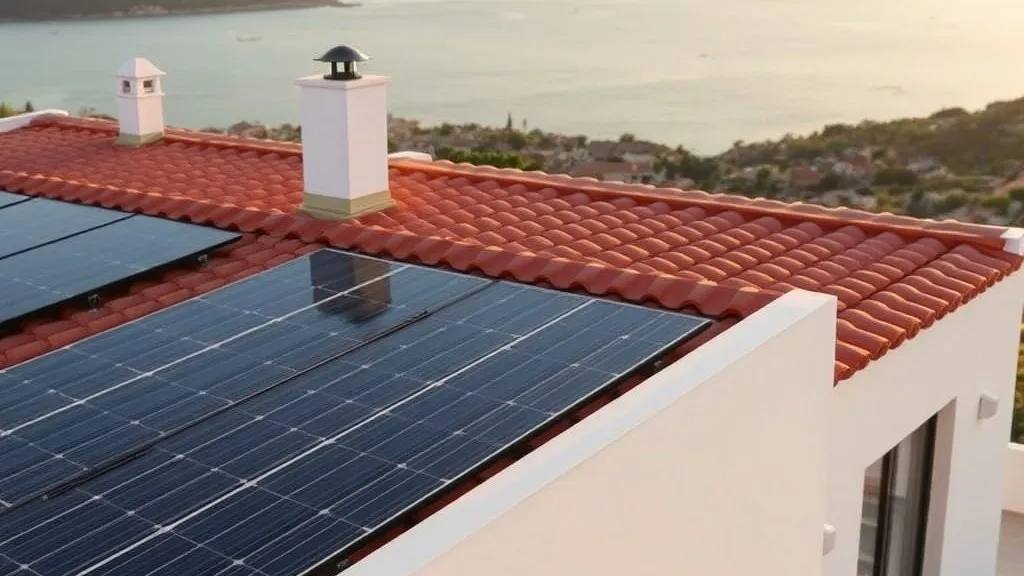
Almost everyone considering solar looks at the roof first: orientation, shading, how many modules will fit. That makes sense, but the installation doesn’t end there. Panels connect to your consumer unit — and in a villa that is twenty or thirty years old, that unit is usually the one part of the house nobody has touched since it was built.
What an electrician checks before anyone climbs onto the roof
Four things, and none of them is a minor detail. In short:
| What gets checked | What usually turns up in a 20–30 year old villa | What it means |
|---|---|---|
| Spare capacity in the unit | Rail full: every refurbishment added a circuit | Extend or replace the consumer unit |
| Protective devices and RCDs | RCDs that haven’t tripped in years | Replace whatever isn’t really protecting |
| Earthing | Degraded, poorly executed or absent | Sort it out before anything is connected |
| Cabling and supply cable | Cross-section marginal for current use | Look at the whole thing, not one run |
Point by point:
Spare capacity in the unit. A self-consumption system needs its own protective devices, and those devices take up physical space on the rail. Plenty of villa consumer units are already full: every refurbishment added another circuit until there was no room left. If there is no space, the unit gets extended or replaced — and that is electrical work, not an accessory to the solar job.
Protective devices and RCDs. Adding a source of generation changes how the installation behaves. The existing protection has to be the right type and in working order — “it still works” isn’t the standard. In older units it is common to find RCDs that haven’t tripped once in years, which is precisely what you don’t want to discover on the day they’re needed.
Earthing. This is the one that causes most trouble. In villas built in the eighties and nineties, earthing turns up degraded, poorly executed, or simply absent. It is not negotiable and not something to leave for later: the safety of the whole installation depends on it.
Cabling and the supply cable to the unit. If the line feeding the consumer unit is already marginal for current consumption, adding generation — and probably more equipment — doesn’t improve matters. The same judgement applies here as when rewiring an old villa: you look at the whole thing, not one isolated run.
The order matters more than it seems
Checking the unit first costs one site visit. Finding out it can’t cope afterwards, with modules already on the roof and the installer waiting, means stopping the job and running two pieces of work back to back that could have been done together.
It’s the same mistake as under-contracting your supply capacity: you don’t notice until you notice, and by then it’s expensive.
If you’re also going to increase your contracted power to cover generation or new equipment, work it out at the same time — we cover that in our guide on what power supply a villa with a pool needs.
Who does what
Worth being clear about, because these are two separate jobs.
We handle the villa’s electrical installation: we inspect the consumer unit and carry out whatever is needed — extension, protective devices, earthing, cabling — and as authorised installers we issue the CIE certificate where it applies. If you’re unsure which document you’re being asked for, we explain it in our guide to the electrical certificate versus the EPC.
The solar installation and its registration are handled by Solar Master, the other brand run by the same team. So you’re not left coordinating two firms that never speak to each other: the electrical side is brought up to standard, and the panels go onto an installation that can actually take them. As both brands share the same authorised low-voltage installer, that installer can also sign the electrical paperwork for the solar installation. And once the panels are in, we repair and repaint whatever the work has touched.
Want to know whether your consumer unit is ready? Tell us about your project and we’ll check it on a site visit, with no obligation.
Shall we talk about your project?
Site visit and no-obligation quote. We reply on WhatsApp or call you whenever suits you.
or ask for a written quote →Keep reading
Guide · Electrical
Opening your Spanish holiday home after winter
A house that has been shut for months tells you what it needs in the first ten minutes: a musty smell, a stain in a corner, a breaker that trips. This is what to check in the electrics and on the walls before the first guests arrive, and which of it is advice rather than law.
Read the guide: Opening your Spanish holiday home after winter
Guide · Electrical
Electricity in your name after buying in Spain
Putting the electricity in your name — the cambio de titular, or change of account holder — is one of the first formalities after buying, and one of the most confusing: many people believe they need a new electrical certificate. If only the name on the contract changes, you do not.
Read the guide: Electricity in your name after buying in Spain