
Guide · Painting
Repainting a holiday rental on the Costa del Sol: washable paint, drying and guests
Suitcases scuff the hallway, guests lean on the wall by the bed, and the cleaner wipes it all down between stays. A holiday rental needs a paint that takes that, a job that fits between two bookings and a flat that has aired before the next check-in.
 By VARELUX team 30 September 2026 · 5 min read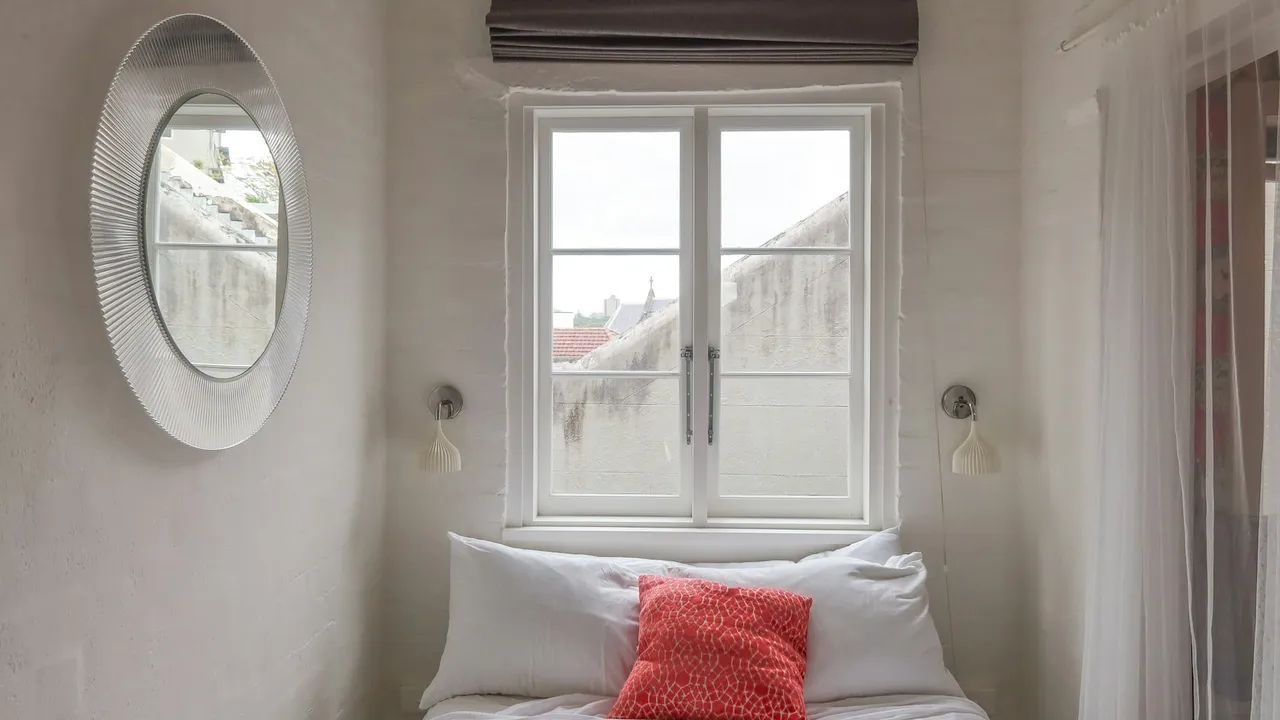
Guests are harder on walls than owners are. Suitcases rub the hallway, hands land on the wall by the light switch, and between stays the cleaner wipes off whatever marks are left. Hosts ask about it in forums, for example how to protect walls from scuff marks from guests’ bags. Part of the answer is a number that should be printed on the paint’s data sheet.
What “washable” means: the EN 13300 classes
Interior wall and ceiling paints are graded under the European standard EN 13300 by how much paint film a wet-scrub test wears away; the test itself is ISO 11998. Class 1 is the most resistant and class 5 the least (table of classes published by the German paint maker Brillux):
| Class | Paint film lost in the test | Where it makes sense in a rental |
|---|---|---|
| 1 | Up to 5 µm after 200 scrub cycles | Hallway, the wall by the bed, around switches |
| 2 | Over 5 and up to 20 µm after 200 cycles | Most walls |
| 3 | Over 20 and up to 70 µm after 200 cycles | Not ideal in a rental: it may not be declared cleanable |
| 4 | Up to 70 µm after 40 cycles | Ceilings |
| 5 | Over 70 µm after 40 cycles | Ceilings |
A µm is a thousandth of a millimetre. The first two columns are the standard’s classes as Brillux publishes them; the third is our advice. If a tin only says “washable” and gives no class, ask for the data sheet: according to Brillux, since 2023 the standard does not allow a paint of class 3, 4 or 5 to be declared cleanable.
Our painter works with top brands. For walls and façades, for example, TitanPRO P-40 Orion, a matt acrylic for outside and inside that its data sheet rates class 2; the same range has a satin version rated class 1 (both in Spanish). Your quote says which paint goes where.
Dry is not the same as hard
Water-based paint dries quickly. The P-40 data sheets give 30 to 60 minutes to dry and 6 to 8 hours before the second coat, at 23 °C and 60 % humidity. But the washability class is measured on paint that has been left to dry for 28 days (Tikkurila explains the test), and paint makers differ on when the film is fully hard: Dulux Trade gives 7 days for its Diamond Matt (data sheet) and Tikkurila about a month for its Harmony (data sheet).
In practice, the paint is dry long before it is hard. Until it is (about a week or a month, depending on the paint; Titan gives no figure for the P-40), the cleaner should wipe marks gently with a damp cloth rather than scrub them. The weather counts too: the P-40 matt data sheet gives 10 to 30 °C and relative humidity under 80 % as application conditions, and says never to apply it below 7 °C or at 80 % humidity or more. On a very humid day, or in a flat that is too hot in summer, the job waits.
Smell and ventilation before check-in
By law, matt paints for interior walls and ceilings may contain at most 30 g/l of volatile organic compounds (VOC), and glossy ones 100 g/l, and the tin must state the product’s subcategory, its legal limit and the product’s maximum VOC content (Royal Decree 227/2006, article 4 and annex II, in Spanish). The P-40 data sheets declare under 18 g/l for the matt and under 10 g/l for the satin.
Even so, paints give off most of their emissions while they dry or cure, generally in the first hours or days after application, although some keep emitting at low levels for longer (note from INSST, Spain’s occupational safety institute, in Spanish), and the US Environmental Protection Agency advises increasing ventilation when using products that emit VOCs (EPA). So we keep the windows open while we paint, and the plan leaves time to air the flat before the next check-in.
Fitting the job between two stays
Plan the gap around three things: the drying time between coats, time for the flat to air, and a final clean. Ask for the number of days in writing, block those days, and ask what happens if the weather holds the job up. And keep the leftover paint tightly closed and labelled with the product and colour, away from heat and out of guests’ reach, for example in a locked owner’s cupboard: small scuffs can then be touched up between stays with the same paint.
If a stain comes back after painting, the cause is usually underneath the paint: find it first, as we explain in what to check on damp walls before painting. A terrace or façade worn by sun and salt needs a different kind of paint; see painting a façade by the sea.
When to repaint
There is no reliable “every so many years” rule for a rental. VisitEngland’s assessors, for example, look at condition, not age: its quality standards for serviced apartments judge walls, ceilings and woodwork on “quality, application and condition” (VisitEngland quality standards). A practical test: repaint when marks no longer come off with a gentle wipe, or when the touch-ups start to show.
If you live abroad, you send us the size of the flat, the rooms and a few photos and, if that is enough, we reply with a fixed written price, showing the VAT and the total, and the number of days, paint between two bookings and send you photos as we go. See how it works for holiday rental owners and what our painting service includes.
Shall we talk about your project?
Site visit and no-obligation quote. We reply on WhatsApp or call you whenever suits you.
or ask for a written quote →Keep reading
Guide · Painting
Work on your Costa del Sol home from abroad
The flat needs painting or new wiring and you are a flight away. Almost all of it can be arranged from home, but six things decide whether it goes smoothly: the quote, the community of owners, the town hall, the VAT, the invoice and who holds the keys.
Read the guide: Work on your Costa del Sol home from abroad
Guide · Painting
Cracked monocapa: elastic or silicate paint?
Monocapa render fades with age and fills with fine cracks, and the question comes straight away: an elastic paint to cover them, or a silicate that lets the wall breathe? It depends on three things, and you can check them.
Read the guide: Cracked monocapa: elastic or silicate paint?